OPEN CALL –  Wort- & Bild Beiträge zur Textilen Forensik

OPEN CALL – Wort- & Bild Beiträge zur Textilen Forensik

OPEN CALL

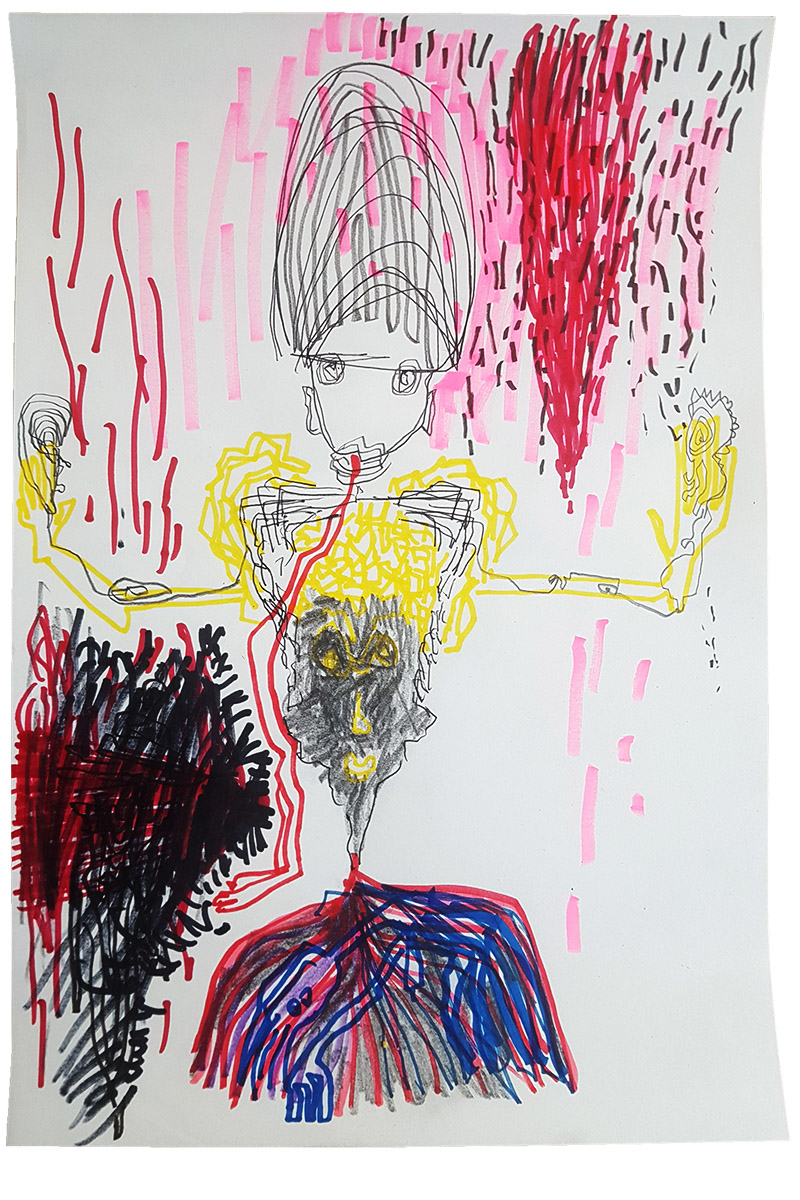
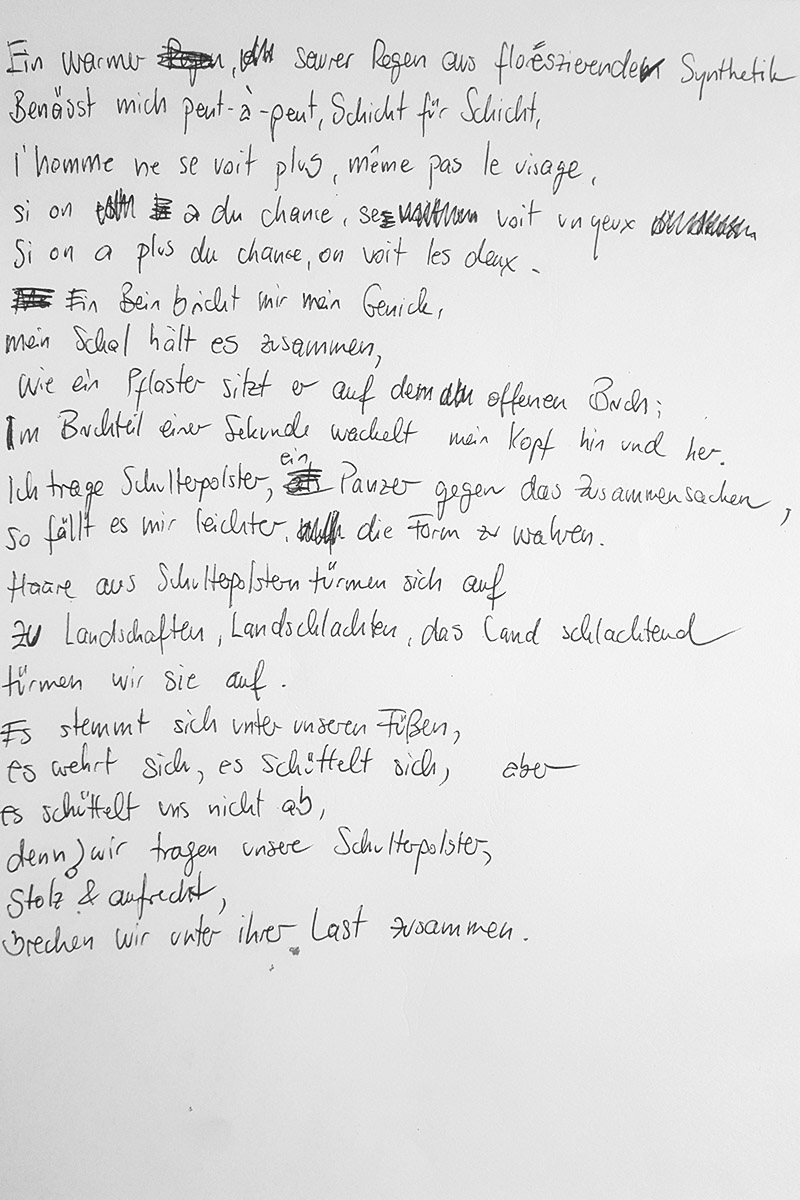
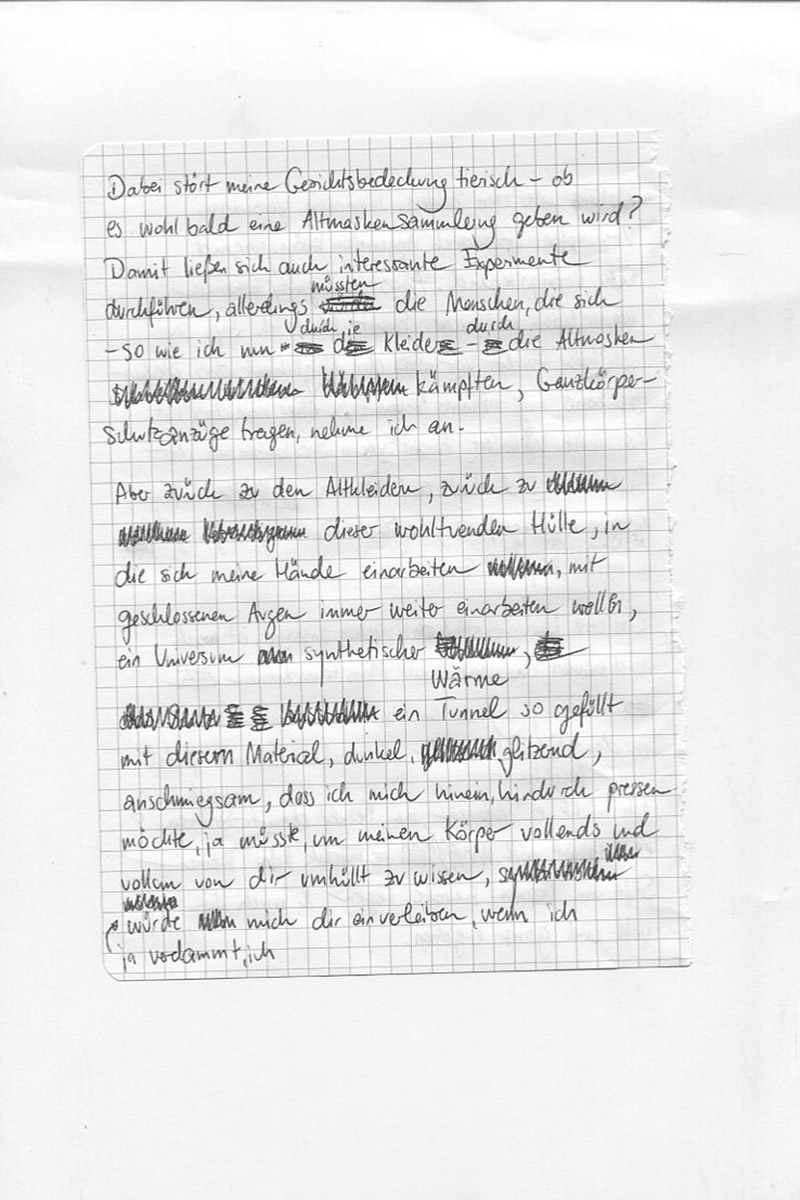
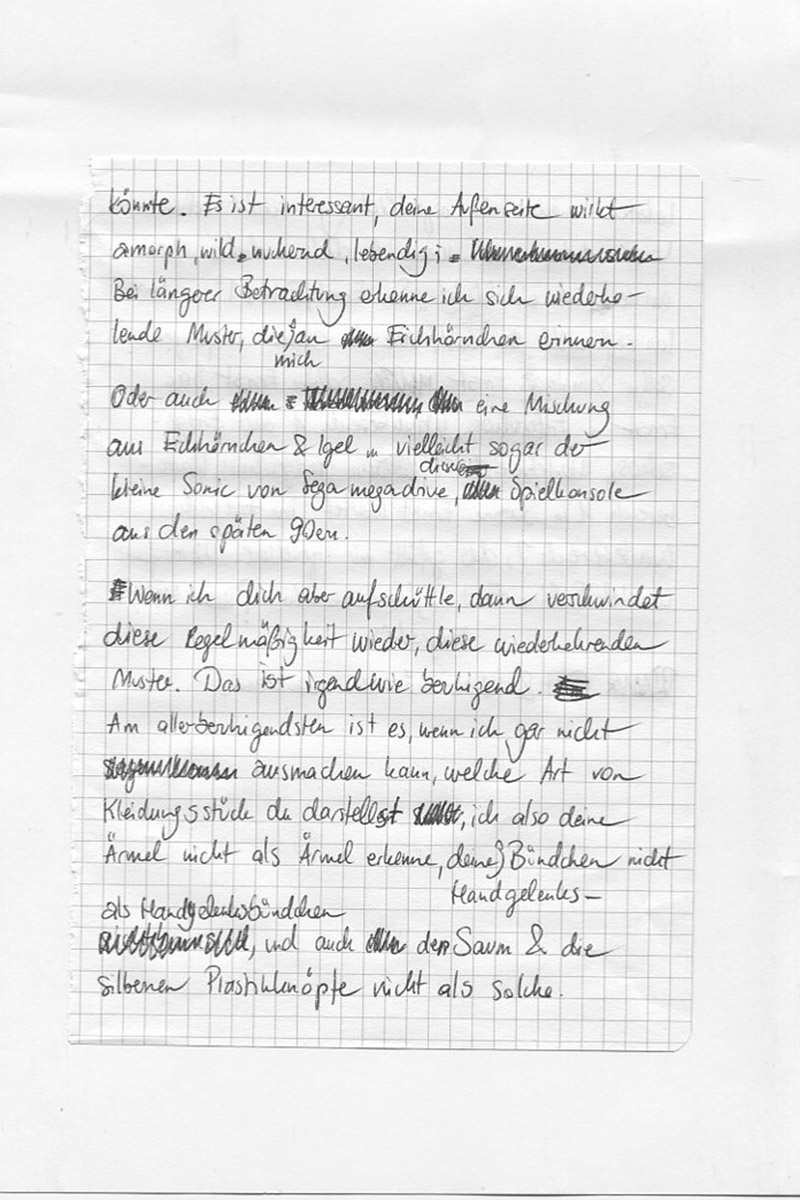
We look forward to receiving submissions in the form of both text and picture or drawings from poets and chroniclers who retrace their own lives – from people who enjoy writing and would like to publish their thoughts on a piece of clothing or their textile observations on our website.

From nappies to shroud –

Clothes accompany us through all stages of life – they characterise those who wear them as trendsetters or fashionistas, as individualists or mainstream enthusiasts. They embellish the everyday and celebrate the extraordinary, they camouflage and construct an image.

Fabric sheaths caress the body and dress our ideas. Hipsters watch the world out of their skinny jeans through heavy glasses. Black turtlenecks, once worn by eagerly debating existentialists, have become the favourite garment of turbo-capitalists, while hoodies are considered a textile statement of anti-fascist ideology. The yawning attitude gap between Kik and Organic Textile could hardly be more blatant.

A towel turban draped over wet hair after a bath is nowadays interpreted as a sign of cultural appropriation.

Clothing protects us from nudity and reveals the Self -
Perception lures the audience into a trap – off to collect more votes in a cardigan, are you?

Bohemian, business, boho, casual, cargo, cocktail, ethno, elegant, hippie, festive or folkloric – the new sporty-urban look boosts our self-image amid a pandemic-induced paralysis. The sofa obstacle course is thus best mastered in a pair of elasticated jersey trousers. A satined influencer on Instagram, Narcissus claims social authority over depressed mindsets.

Sweat, perfume, bodily fluids: Fabrics store emotions. A t-shirt smells of love, a sweater of lost aspirations vanished with the smoke of a cigarette.

Clothes are the fabric history is made of.

We invite you to freely choose the literary format of your submission. The texts will be published at fabric sample  . Feel free to send a drawing or a photo of the described garment to

waschsalon@streetware-saved-item.net

barbara caveng | Alice Fassina | Mareen Butter
 

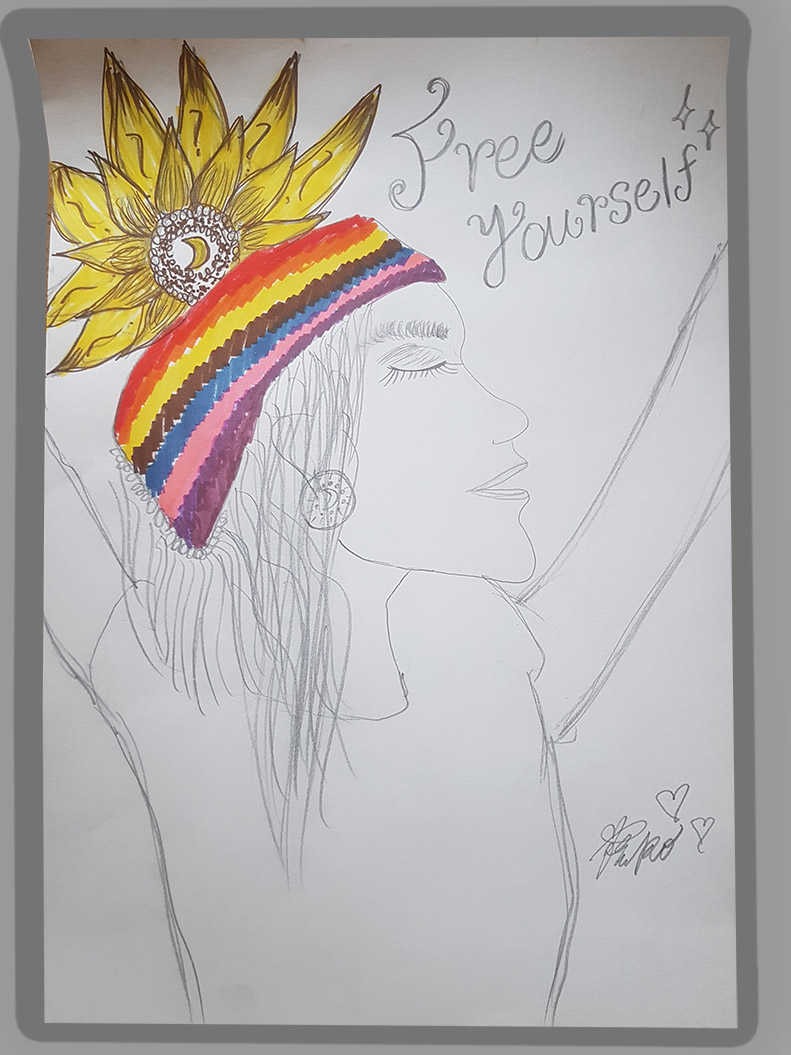
Free Yourself

Free Yourself


Free Yourself

Kiko


My name is Kiko. I am an ethical model, consciously working with ethical and sustainable brands who are making the world a better place. https://kiko.book.fr/ I support fashion that’s kind to our planet, people and animals. And I believe even a model can be a voice for positive change. I‘ve also founded an ethical model agency called Ethical Models to connect sustainable brands with models who share their values so that they can work together and make a bigger impact!

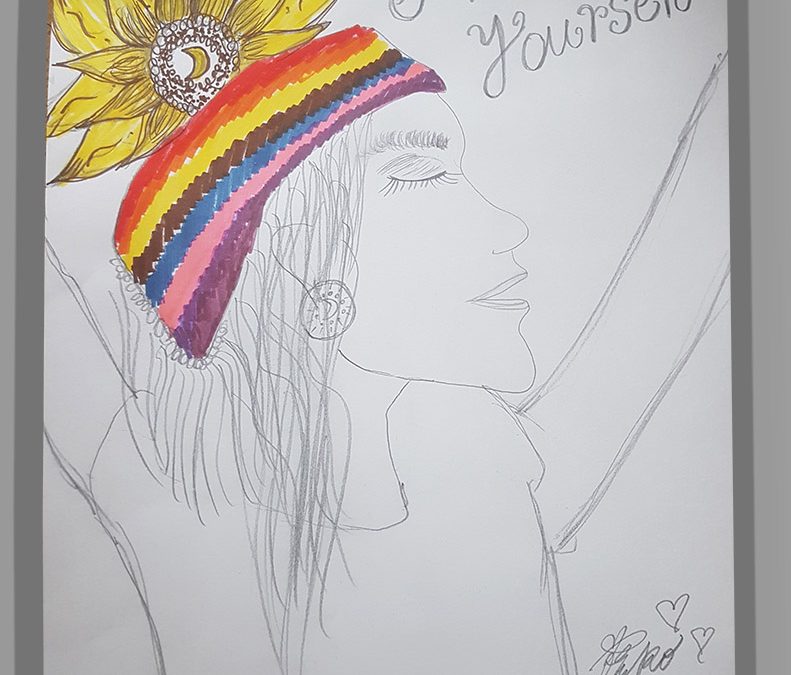
Regarding my art, I have some words to say - I picked up a colourful scarf and I am planning to use it to free and be myself. In life, there are many expectations from society or your family but at the end of the day, you have to choose to be yourself and do what makes you happy. I also feel like the scarf came from someone who prioritizes her sense of self. It is time to break free from expectations and free yourself.

übersetzt aus dem Englischen von barbara caveng

'The first true storyteller is, and will continue to be, the teller of fairy tales. ... always the art of repeating stories, and this art is lost when the stories are no longer retained' Walter Benjamin

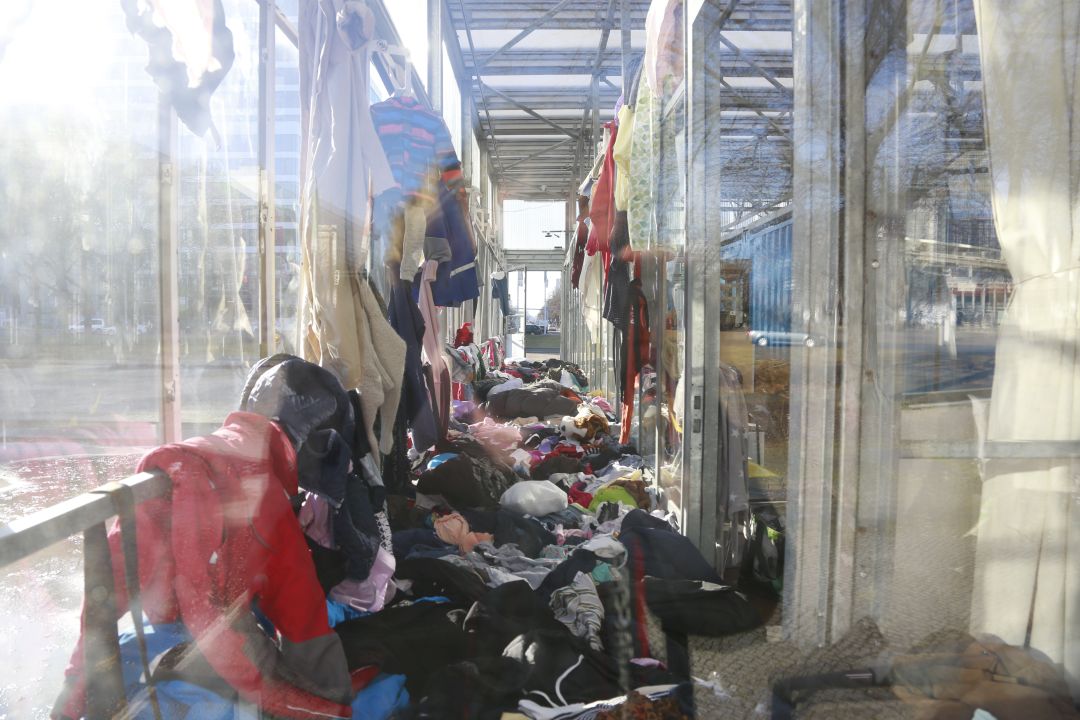
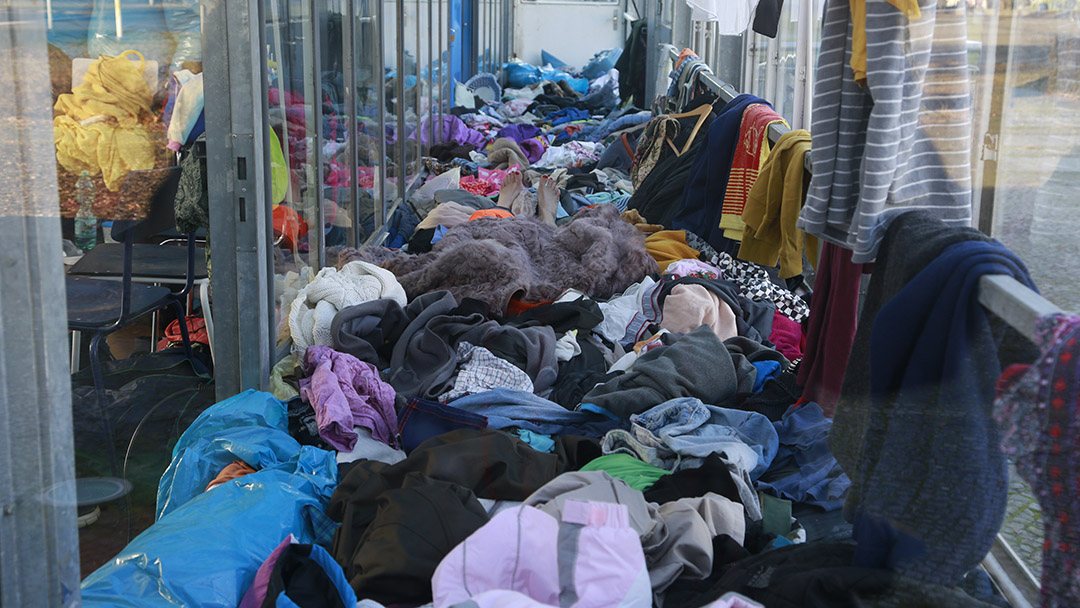
From 21 to 22 February, eight performers spent 24 hours digging through a textonic landscape of 45 m³ of old clothes from planetary dwellers.

Their own bodies were wrapped and deformed by new and old, used or even still labelled pieces, whose value was already decaying in the hours of the creation & production process under the hands of the sewers. The prospectors infiltrated dunes of down jackets, excavated pits and penetrated the penetrating the innermost of materiality. No safe footing was possible. From the pile of clothes, they gazed out on the discarded landscape of Anthropozaen.
What stories and thoughts did they uncover? What can be explored, read and told of the discarded clothing that is contemporary civilisational history.

On 27 February, we invited chroniclers and word-finders to write down their thoughts on the textonic landscape of the BHROX bauhaus reuse as poems, essays, novellas or notes. We publish the texts in loose series.
Kiko nahm daran während einer Pause innerhalb eines Fotoshootings teil.

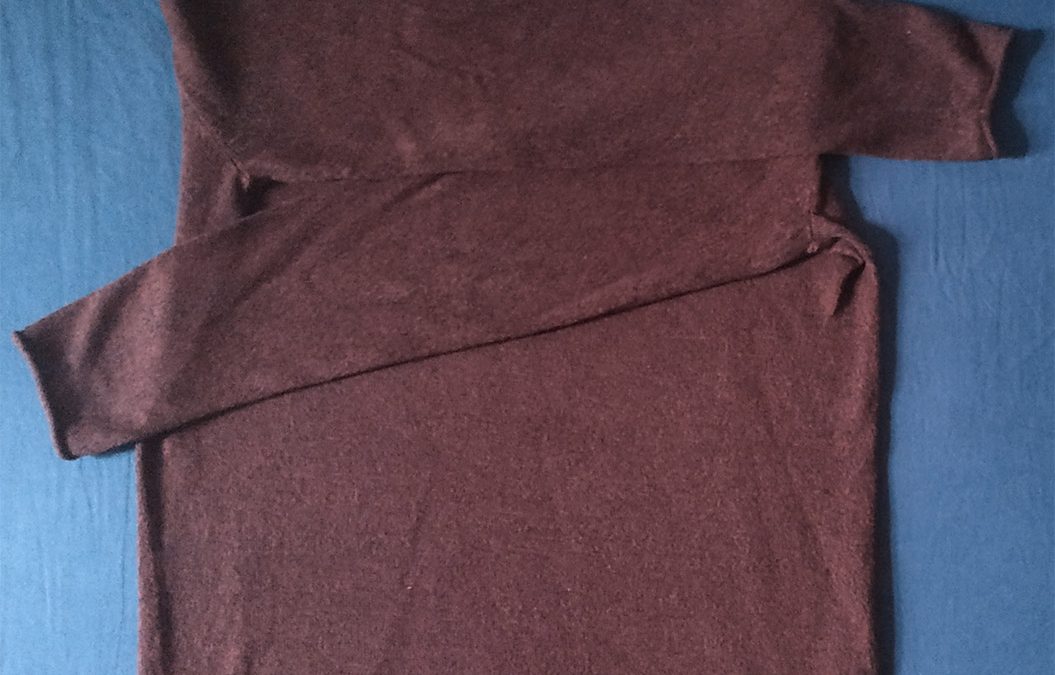
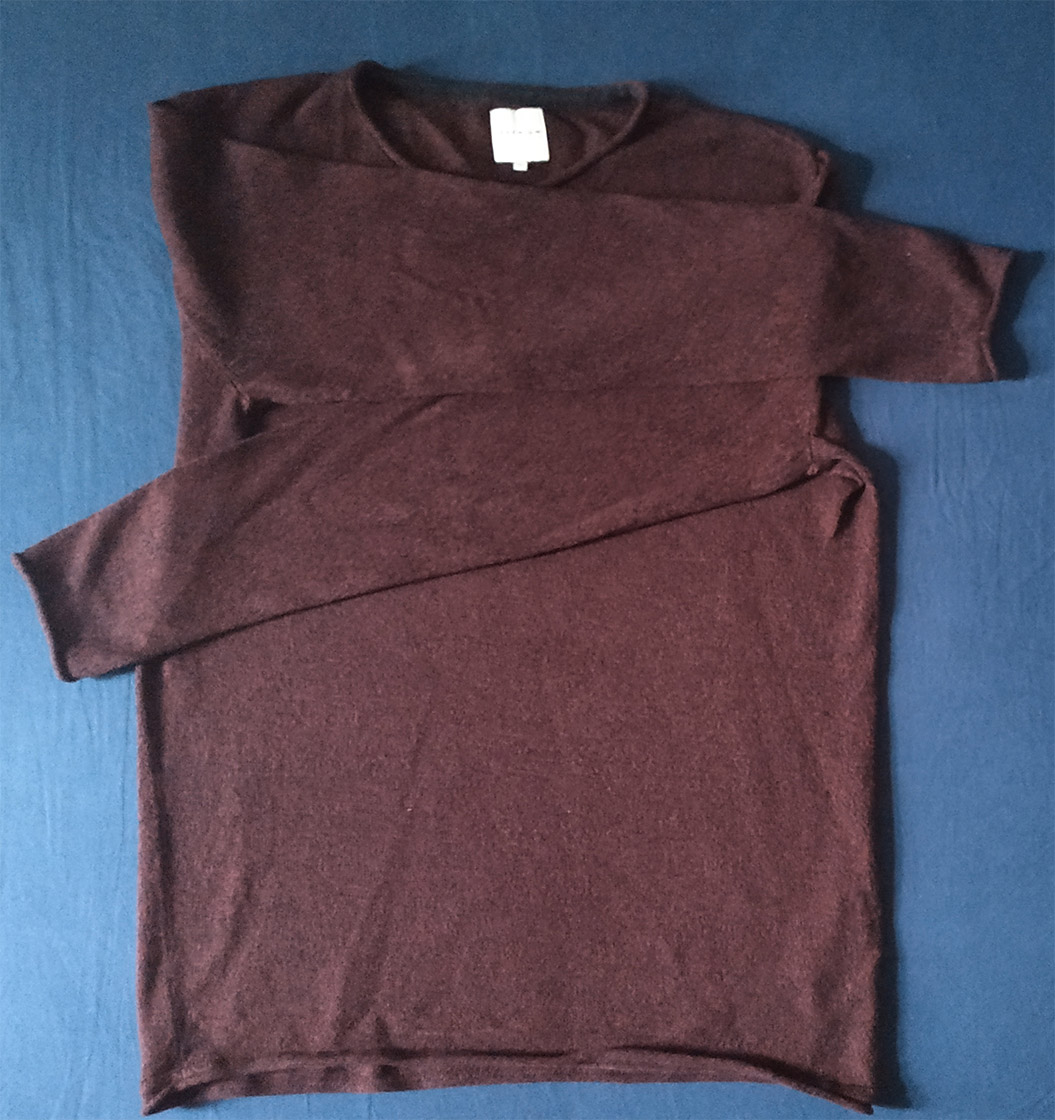
Pullover

Pullover


Pullover

Paolo Gallo 


Quanti corpi avrai scaldato e quanti ne avrai abbracciati e magari quanti hanno pianto su di te? O ti hanno odorato per sentire di qualcun’altro.
Un viaggio lungo ti ha portato a me per coincidenze o per destino e per quanto staremo insieme? Ti stringerai quando ingrasseró e per non buttarti ti donerò a qualcun’altro per continuare il tuo lavoro, scaldare le persone..

Paolo Gallo

'I was born in Italy and live in Berlin.
I am a self taught photographer,
I'm fascinated by the everyday situations, I observe my surroundings in search of inspiration and experimentation.

'The first true storyteller is, and will continue to be, the teller of fairy tales. ... always the art of repeating stories, and this art is lost when the stories are no longer retained' Walter Benjamin

From 21 to 22 February, eight performers spent 24 hours digging through a textonic landscape of 45 m³ of old clothes from planetary dwellers. Paolo accompanied them photographically on the clothes heap.

Their own bodies were wrapped and deformed by new and old, used or even still labelled pieces, whose value was already decaying in the hours of the creation & production process under the hands of the sewers. The prospectors infiltrated dunes of down jackets, excavated pits and penetrated the penetrating the innermost of materiality. No safe footing was possible. From the pile of clothes, they gazed out on the discarded landscape of Anthropozaen.
What stories and thoughts did they uncover? What can be explored, read and told of the discarded clothing that is contemporary civilisational history.

On 27 February, we invited chroniclers and word-finders to write down their thoughts on the textonic landscape of the BHROX bauhaus reuse als as poems, essays, novellas and notes. We publish the texts in a loose series.

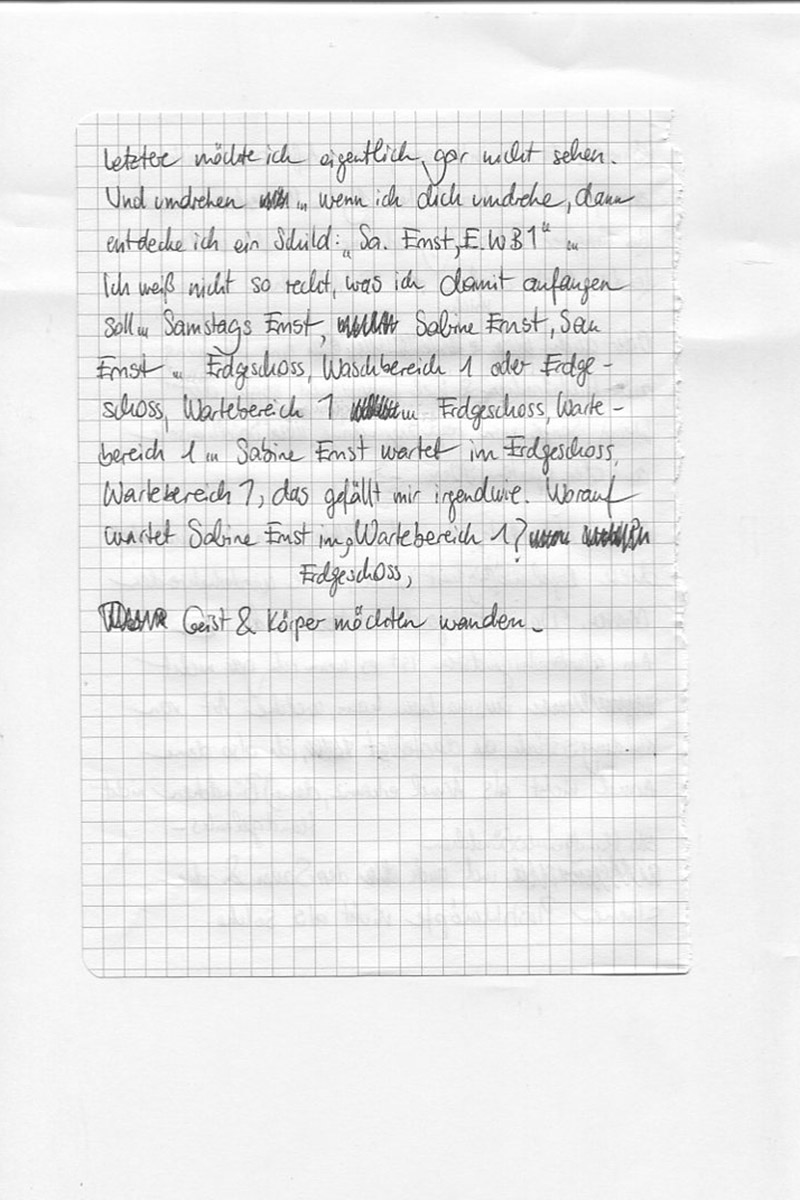
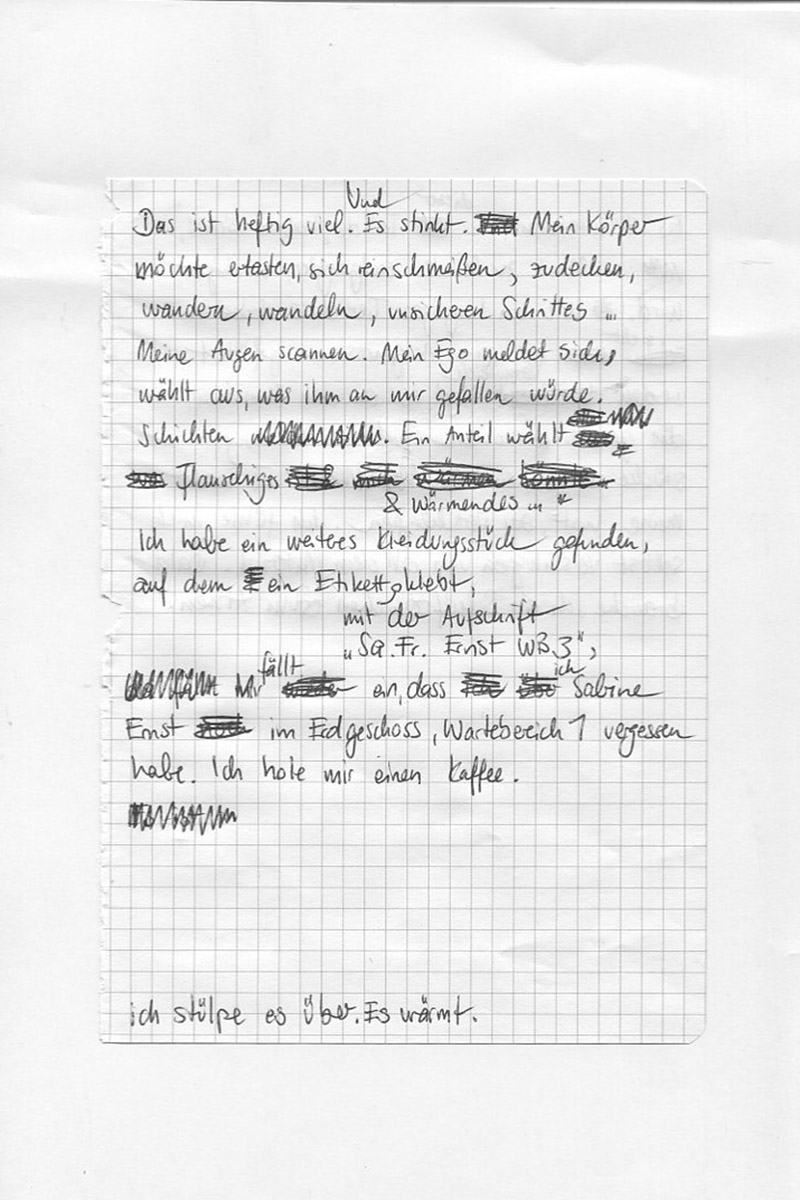
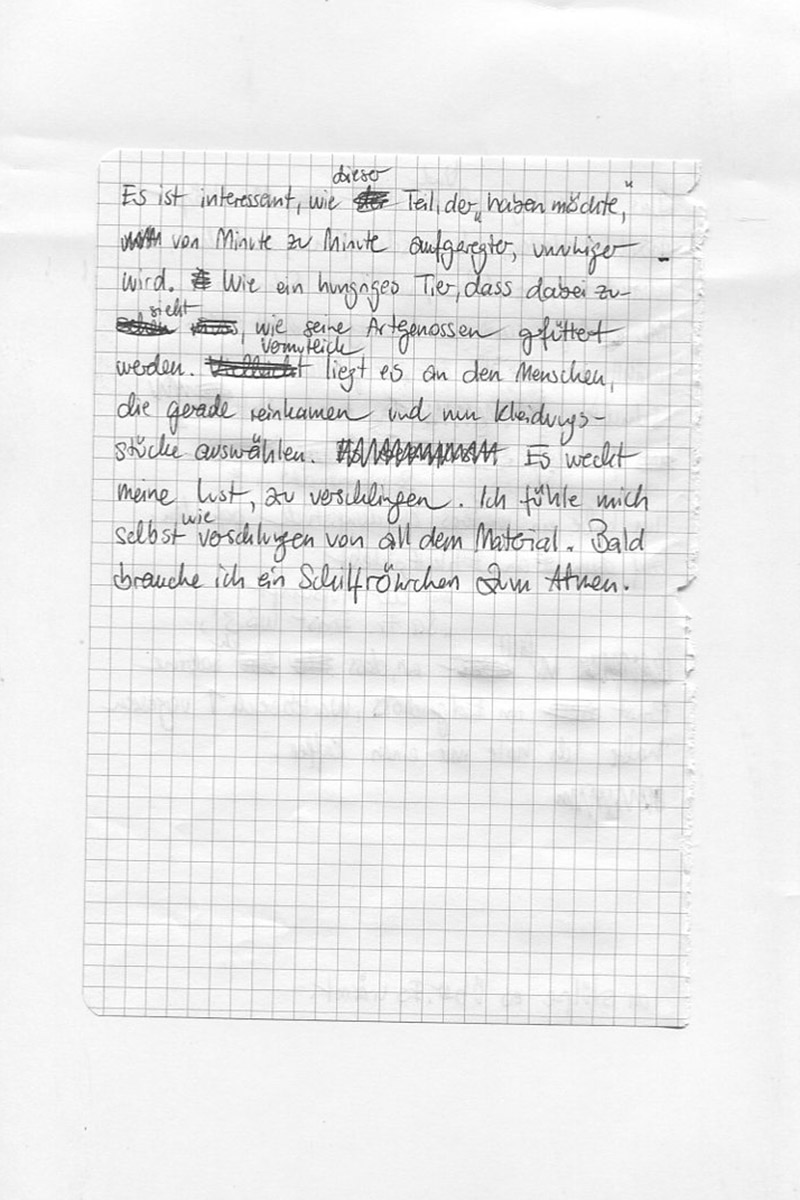
Worauf wartet Sabine Ernst im Wartebereich1 im Erdgeschoss?

Worauf wartet Sabine Ernst im Wartebereich1 im Erdgeschoss?

Worauf wartet Sabine Ernst im Wartebereich 1 im Erdgeschoss?

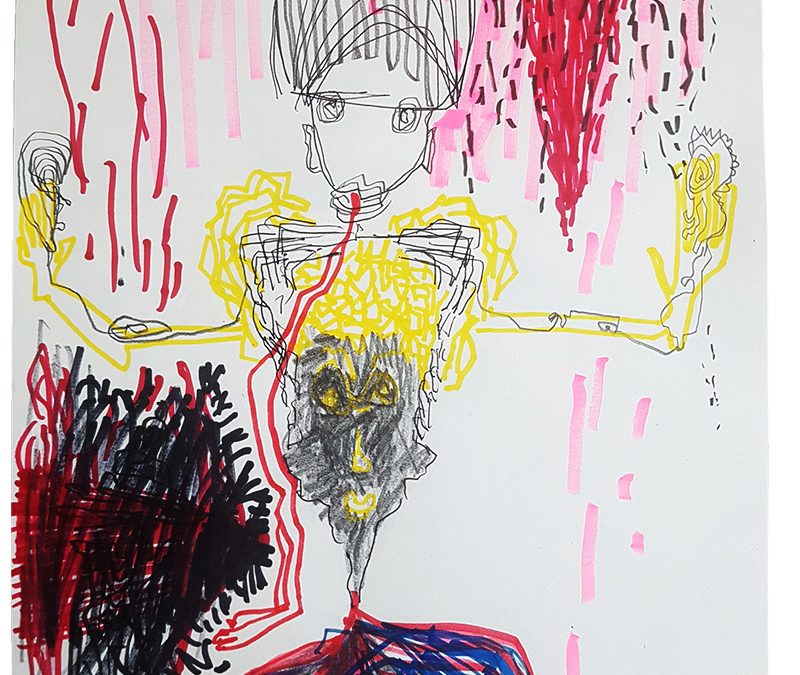
Assoziationen aus dem SCHURF von Caro Speisser

'The first true storyteller is, and will continue to be, the teller of fairy tales. ... always the art of repeating stories, and this art is lost when the stories are no longer retained' Walter Benjamin

From 21 to 22 February, eight performers spent 24 hours digging through a textonic landscape of 45 m³ of old clothes from planetary dwellers.

Their own bodies were wrapped and deformed by new and old, used or even still labelled pieces, whose value was already decaying in the hours of the creation & production process under the hands of the sewers. The prospectors infiltrated dunes of down jackets, excavated pits and penetrated the penetrating the innermost of materiality. No safe footing was possible. From the pile of clothes, they gazed out on the discarded landscape of Anthropozaen.
What stories and thoughts did they uncover? What can be explored, read and told of the discarded clothing that is contemporary civilisational history.

On 27 February, we invited chroniclers and word-finders to write down their thoughts on the textonic landscape of the BHROX bauhaus reuse as poems, essays, novellas and notes. We publish the texts in a loose series.

Wie pervers ist das denn?

Wie pervers ist das denn?

Kunstaktion „Schurf“ zum Überkonsum billiger Kleidung und seinen Folgen

Manuela Lintl widmet uns ihre Gedanken zu SCHURF  in ihrem Blog mit Veröffentlichungen zu  Kunst, Gesellschaft und Aktivismus .
Der Beitrag erschien am 2.3.2021 und ist weiterhin hier nachzulesen…
Zur Druckansicht geht es hier >

Wissenschaftliche Stipendiat:in zur empirischen Erforschung unseres interdisziplinären Kunstprojektes gesucht

Wissenschaftliche Stipendiat:in zur empirischen Erforschung unseres interdisziplinären Kunstprojektes gesucht

Wir suchen ……

challenges fast fashion sucht zum schnellstmöglichen Zeitpunkt, spätestens zum 1.4.2021 bis 31.7.2021 eine:n frei arbeitende:n wissenschaftliche:n Mitarbeiter:in, der:die unser partizipatives Kunstprojekt als Stipendiat:in empirisch begleitet.
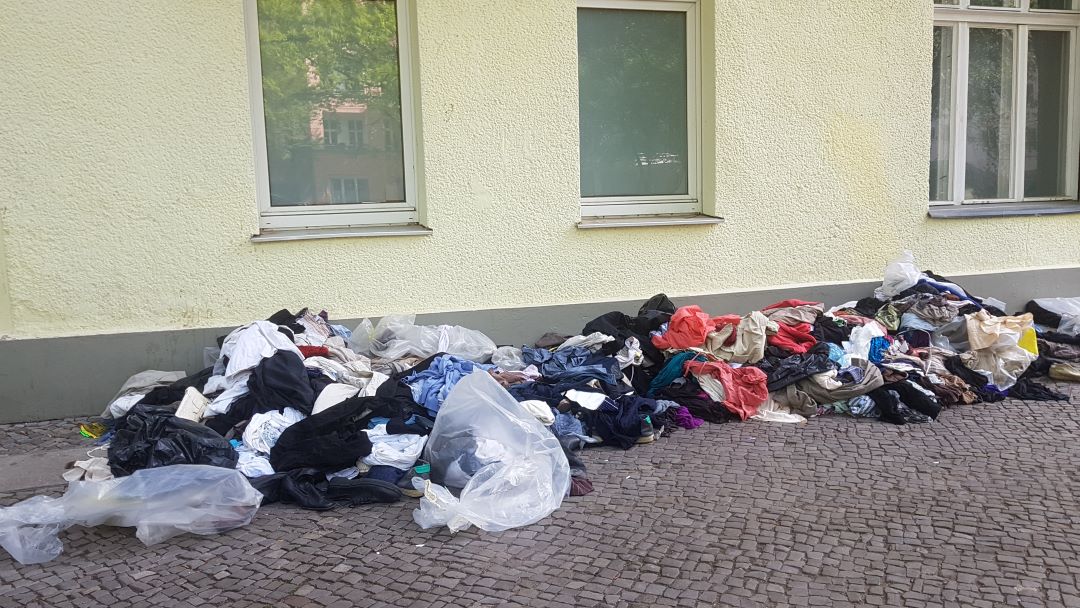
challenges fast fashion ist ein partizipatives Kunstprojekt zum Thema Nachhaltigkeit und Wiederverwertung, kurz gesagt, der Circular Economy. Am Beispiel des Berliner Bezirks Neukölln behandelt das Projekt globale sozial-ökologische, ökonomische und ästhetische Fragestellungen. Unser Material sind im öffentlichen Raum entsorgte Textilien. In den Berliner Straßen säumen Pullover, T-Shirts und Hosen Rinnsteine und Hauseingänge. challenges fast fashion untersucht diese Kultur der „abgestreiften Kleidung” auf ihre gesellschaftliche Bedeutung hin: Was sagt sie aus über unseren Konsum, über unsere Produktionsweisen, über unsere Identität? Wie kann Weggeworfenes in Wertvolles transformiert werden und nutzbringend sein für Menschen ohne Obdach oder Menschen, die fliehen mussten?

challenges fast fashion lädt alle Repräsentant:innen der Gesellschaft zur Mitwirkung ein. Wir setzen unterschiedliche künstlerische Strategien ein: Als Lumpensammler:innen ziehen wir  corona-konform mit fahrbaren Wäscheständern durch die Stadt und heben Textilien auf. Wir planen Workshops auf der Bleichwiese und großangelegte Performances und Installationen in Ausstellungsräumen. Wir veranstalten einen Kongress auf der Kleiderhalde und kommen mit Passant:innen ins Gespräch. Das gefundene Material dient uns als Ausgangspunkt für Neuschöpfungen aller Art. Wir tauschen uns mit Menschen ohne Obdach über textile Architekturen aus. Unsere Basis in Neukölln ist unser Labor und „Waschsalon”, wo wir produzieren, experimentieren und uns vernetzen. Wir spielen mit des Kolonialismus alter und neue Kleider: Den Projektabschluss bildet ein fulminanter Lumpenball.
Die Themen Wiederverwertung, Nachhaltigkeit, Re- und Upcycling sollen neben der partizipativ/künstlerischen Sichtweise auch aus anderen, zum Beispiel einer politischen, soziologischen oder philosophischen Perspektive aus beleuchtet werden. 

challenges fast fashion wurde 2020 von der bildenden Künstlerin barbara caveng und der Kostümbildnerin Alice Fassina gegründet und steht unter der Trägerschaft von KUNSTASYL e.V..  challenges fast fashion wird gefördert von der Hans Sauer Stiftung und dem Fonds Soziokultur Bonn, der das Projekt auch für den Innovationspreis 2021 nominiert hat.
Wir kooperieren mit Künstler:innen, Wissenschaftler:innen, Universitäten, Initiativen und Vereinen – lokal, national und international.
Aktuell ist unser Team auf der Suche nach einem:r wissenschaftliche:n Mitarbeiter:in, die oder der Interesse daran hat, unser Projekt empirisch zu begleiten. Falls du dich in deiner wissenschaftlichen  Arbeit Themen beschäftigst, die mit dem Kunstprojekt ‚STREETWARE saved item’ übereinstimmen, freuen wir uns sehr, von dir zu hören. Bei der Zusammenarbeit mit uns bist du Teil unseres Teams, nimmst an der Projektentwicklung und deren Umsetzung teil. Du kannst teilnehmend beobachten und Interviews/ Gespräche führen und hast Einblick in unser Arbeitsmaterial. Wir gewähren einen Zuschuss zu den Lebenshaltungskosten in Form eines Stipendiums in Höhe von 750.-€/ Monat. 
Bewerbungen sind ohne Einschränkung in Bezug auf Geschlecht, Alter und sonstige Identitätsmerkmale von allen Menschen* erwünscht. Wir möchten unser Team divers gestalten und laden insbesondere BIPoC herzlich ein, sich zu bewerben.

Wir freuen uns auf aussagekräftige Bewerbungen inklusive Lebenslauf und der Formulierung deines Arbeitsansatzes an  ​waschsalon@streetware-saved-item.net​ zum schnellstmöglichen Zeitpunkt.


EN